.png)
.png)
%20-%20Copy.png)
.png)
.png)
COMPUTATIONAL FLUID DYNAMICS CFD ANALYSIS SERVICES IN SAUDI ARABIA
ASPAR Engineering provides CFD analysis services in Saudi Arabia to assess, validate, and optimize airflow, cooling, ventilation, thermal management, and smoke extraction performance for engineering systems and facilities.
Our CFD services support HVAC systems, data center cooling rooms, generator rooms, communication shelters, IDF rooms, electrical rooms, low voltage rooms, UPS rooms, stadium ventilation, atrium ventilation, car parks, and tunnels.
We use advanced CFD simulation tools, including Ansys, to evaluate air movement, temperature distribution, pollutant dispersion, smoke behavior, and ventilation performance before implementation or system modification.
ASPAR is also aligned with NAFEMS engineering analysis practices, supporting reliable simulation workflows, technical validation, and practical recommendations for complex HVAC and airflow challenges.
Advantages
-
Identify issues before implementation
-
Design & performance evaluation
-
Analyze complex or high-risk scenarios
-
Optimize HVAC and ventilation performance
-
Cost-effective engineering decisions
Why Choose ASPAR for CFD Analysis in Saudi Arabia?
Optimized HVAC Performance
Evaluate airflow, temperature distribution, cooling performance, and ventilation behavior to support efficient HVAC system operation.
Design & Performance Evaluation

Use CFD simulation to assess system designs, compare operating scenarios, and support better engineering decisions before installation or modification.

Problem Prevention
Identify airflow, cooling, ventilation, pollutant dispersion, or smoke control issues early to reduce operational risk and improve system reliability.
.png)
.png)
Our scope of work
Car Park Ventilation CFD Simulation for CO and CO₂
CFD analysis for car park ventilation systems simulates airflow, air quality, CO and CO₂ dispersion, and exhaust performance inside parking structures.
The objective is to optimize ventilation design, manage pollutant movement, support smoke extraction strategies, and improve safety and comfort within car park environments.
.png)
Our scope of work
Fire Dynamics CFD Simulation
Fire dynamics simulation helps evaluate smoke behavior, temperature distribution, air movement, and toxic gas concentration during fire development.
Using CFD-based fire simulation methods, ASPAR supports safer smoke control design, emergency scenario assessment, and performance evaluation for complex building environments.
.png)
Our scope of work
Toxic Gas Dispersion CFD Analysis
CFD analysis helps evaluate carbon monoxide, CO₂, toxic gas dispersion, and ventilation effectiveness in car parks, tunnels, and enclosed facilities.
The analysis supports safer ventilation design, pollutant control, and compliance-oriented engineering decisions for occupied environments.
.png)
Our scope of work
Misting System CFD Simulation
CFD analysis for misting systems helps simulate mist dispersion, airflow patterns, cooling effect, humidity distribution, and air movement across the target area.
The results support better nozzle placement, cooling performance, comfort conditions, and energy-efficient system design.

Our scope of work
Atrium Smoke Evacuation
By utilizing advanced CFD simulation, it assists engineers in designing efficient and reliable smoke management systems for atriums, platforms, concourses, and mezzanines.
A comprehensive recommendation is provided to ensure maximum safety and full compliance with industry standards. This approach strictly adheres to international standards and local codes such as NFPA, SFPE, ASHRAE, and the Saudi Building Code.
.png)
Our scope of work
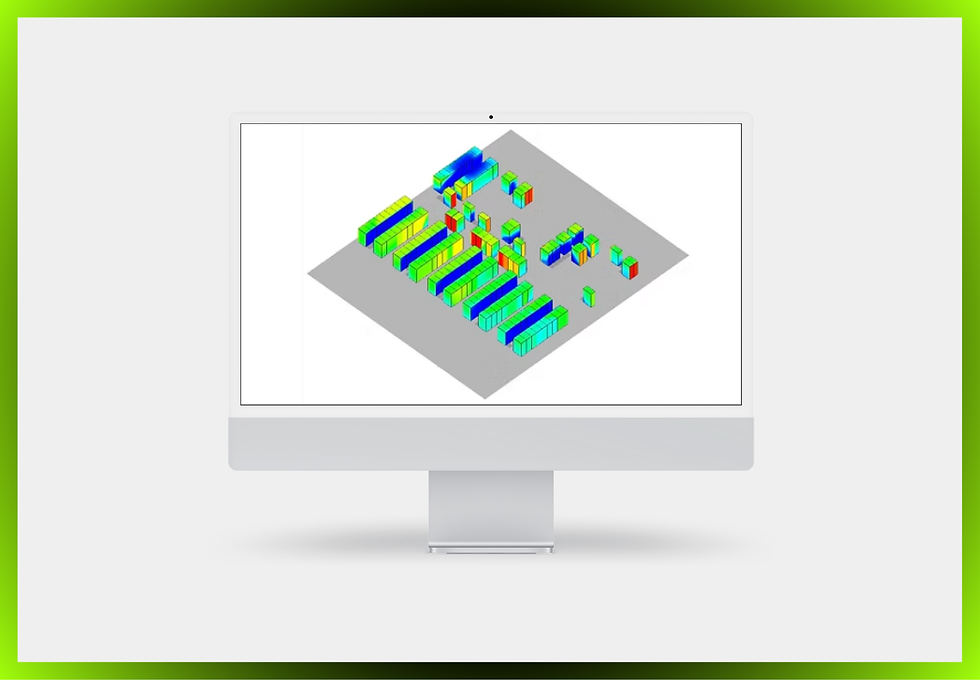
Data Center Cooling CFD Analysis
CFD analysis for data centers helps evaluate cooling airflow, rack heat load, hot spots, air leakage, and temperature distribution across server rooms.
The objective is to support reliable cooling performance, reduce overheating risk, improve airflow management, and validate layout or system changes before implementation.
.png)
Our scope of work
Thermal Comfort CFD Analysis
Thermal comfort CFD analysis helps evaluate airflow, temperature distribution, air velocity, and indoor environmental conditions based on recognized comfort criteria.
The results support HVAC layout optimization, better occupant comfort, and improved performance across commercial, industrial, healthcare, and mixed-use facilities.
.png)
Our scope of work
Chiller and Heat Exchanger CFD Simulation
CFD simulation helps evaluate heat exchanger behavior, condenser performance, airflow patterns, and heat transfer under different operating conditions.
The analysis supports better chiller system performance, equipment validation, energy efficiency, and reliable HVAC operation.
.png)
Our scope of work
Generator Room CFD Analysis
CFD analysis for generator rooms helps evaluate heat distribution, ventilation airflow, exhaust discharge, and cooling performance.
These insights support safer room layouts, better equipment ventilation, improved air quality, and more reliable generator room operation.
.png)
Our scope of work
Atrium Smoke Evacuation CFD Analysis
CFD simulation helps evaluate smoke movement, visibility, temperature behavior, and smoke extraction strategies in atriums, platforms, concourses, and mezzanines.
The analysis supports practical smoke management recommendations aligned with recognized standards and project requirements in Saudi Arabia.
.png)
Our scope of work
Cooling Tower CFD Performance Analysis
CFD analysis for cooling towers helps evaluate airflow, water flow, heat rejection, outlet water temperature, wet-bulb conditions, and ambient effects.
The results support cooling tower performance assessment, energy efficiency improvements, maintenance planning, and reliable heat rejection operation.
.png)
Our scope of work
Water Flow CFD Analysis
Water flow CFD analysis helps simulate flow behavior, pressure distribution, turbulence, stagnation zones, and cavitation risk in water-based systems.
It supports better design and performance evaluation for water distribution, wastewater treatment, hydraulic structures, passive mixing, and cooling systems.
.png)
Our scope of work
Football Stadium CFD Analysis
CFD analysis for football stadiums helps evaluate airflow patterns, wind effects, thermal comfort, ventilation behavior, and microclimatic conditions.
The analysis supports better spectator comfort, air quality, roof aerodynamics, pollutant dispersion control, and energy-efficient stadium ventilation design.
.png)