Chiller Rated for 55°C Ambient Temperature in Saudi Arabia: How to Specify High-Ambient Cooling Without Losing Capacity
A practical engineering guide for KSA projects, rooftops, data centers, hospitals, commercial buildings, and mission-critical facilities
Direct answer Yes. Publicly documented air-cooled chillers are available with stated 55°C ambient capability. However, “operates up to 55°C” is not the same as “delivers full design capacity at 55°C.” For a Saudi project, the engineer should require a model-specific application selection at the actual 55°C condenser-entering air condition, showing net cooling capacity, total unit input power, efficiency, compressor/fan operating status, and the required installation clearances. A nominal catalog rating alone is not sufficient. |
For Saudi Arabia, 55°C is best treated as a project-specific physical constraint, not as a universal design temperature for every site. The design basis should come from recognized climatic data, the owner/consultant criteria, and the actual installation environment. ASHRAE publishes 0.4%, 1.0%, and 2.0% cooling design temperatures through its Weather Data Center, and these are commonly used for HVAC sizing. Where a project specification intentionally requires continuous operation at 55°C, the chiller must be selected and documented at that condition rather than assumed to comply because it is described as “high ambient.”
What does “chiller rated for 55°C ambient” actually mean?
This phrase is used loosely in the market, so procurement teams should separate several different claims. Two products may both advertise “55°C” and still deliver very different capacity, power consumption, and operating margin at that temperature.
Claim | What it can mean | What the engineer must still verify |
Maximum operating ambient | The unit control envelope allows operation up to 55°C. | Does not automatically prove full design capacity at 55°C. |
Full-load capacity at 55°C | The selected unit produces the required project duty at 55°C. | This is the most useful procurement requirement. |
Validated/tested to 55°C | The manufacturer has validated operation in a laboratory or test facility at 55°C. | Confirm the tested model/configuration and whether the result represents full project duty. |
Short excursion above 55°C | The unit can remain online for limited periods above the rated ambient. | Not a substitute for continuous 55°C design performance. |
Storage/shipping temperature | Components can be stored at a stated high temperature. | This is not an operating rating and should never be used as one. |
The strongest specification wording is therefore not “chiller suitable for 55°C.” It is: “the chiller shall deliver not less than the scheduled net cooling capacity at 55°C dry-bulb air entering the condenser, at the stated chilled-water conditions, site elevation, fluid, fouling factor, voltage and project options.”

Figure 1. Why the 55°C design point must be treated as a performance condition, not only an operating limit.
Why high ambient temperature is a real physical constraint
An air-cooled chiller rejects heat directly to outdoor air. As condenser-entering air temperature rises, the refrigeration system generally has to operate at a higher condensing temperature and pressure. That increases compressor lift and can increase power input while reducing the cooling capacity available from a given compressor-condenser combination. The exact effect is model-specific; there is no defensible universal derating percentage that can be applied to every chiller.
High ambient operation also reduces margin against high head pressure, increases the importance of condenser airflow, and places more demanding thermal conditions on fan motors, variable-speed drives, controls and electrical panels. That is why a chiller selected only from nominal catalog tables can be materially undersized for an extreme-ambient project even when the nominal tonnage appears correct.
Is 55°C required everywhere in Saudi Arabia?
No. A 55°C design requirement should not be applied automatically to every project in the Kingdom. Saudi projects span different cities, elevations and microclimates, and the correct outdoor design condition should come from the project basis of design and recognized climatic data. ASHRAE’s Weather Data Center provides current climatic design information for worldwide locations, including dry-bulb, wet-bulb, dew-point, wind and extreme-temperature statistics.
A consultant may still specify 55°C for resilience, owner standards, exposed rooftops, critical facilities, or a conservative equipment envelope. In that case, the procurement requirement should explicitly state whether 55°C represents the weather design dry bulb, the air temperature entering the condenser coil, or a maximum survival/operation point. These are not interchangeable.
Critical KSA design point For rooftop and screened installations, the condenser may inhale air hotter than the meteorological ambient because of discharge-air recirculation, nearby walls, parapets, adjacent chillers or solar-heated surfaces. The project should therefore verify the actual condenser inlet condition, not only the weather-station temperature. |
Publicly documented chillers with 55°C ambient capability
The following examples were verified from publicly available manufacturer or manufacturer-regional sources. They are included to show that true 55°C product options exist; they are not endorsements and they do not replace project-specific selection software, local compliance review, or commercial availability checks.
Public example | Technology | Published high-ambient statement | Engineering note |
Daikin EWAD-MZ | Air-cooled inverter screw | Up to 55°C ambient; 150-1,950 kW at stated Middle East conditions. | Official Daikin Applied product page. |
Carrier AquaForce 30KAV | Variable-speed air-cooled screw | High-ambient option up to 55°C; nominal range 490-1,100 kW. | Official Carrier Saudi Arabia product page. |
Trane Ascend ACR | Variable-speed screw data-center chiller | Rated for ambient up to 131°F (55°C); up to 2 MW. | Official Trane product page; short excursions above 55°C are also described. |
Airedale TurboChill DCS | Oil-free centrifugal | High-ambient operation validated up to 55°C; 800 kW-2 MW. | Official Airedale by Modine product page. |
Dunham-Bush ACHX-BH | Air-cooled screw | Able to operate up to 55°C; 90-418 TR (315-1,470 kW). | Official Dunham-Bush regional product page. |
Smardt AD Series (public 2026 brochure) | Oil-free centrifugal | Public brochure states high-lift operation optimized for ambient up to 52°C. | Useful high-ambient benchmark, but it is not a public 55°C rating. |
This comparison illustrates why engineers should not infer a 55°C rating from brand reputation or compressor technology alone. For example, Smardt’s publicly available 2026 AD Series brochure states operation optimized up to 52°C, while Smardt’s AeroPure announcement refers to optional extreme high-ambient extensions without publishing an exact 55°C limit on the public page. A project requiring 55°C should therefore use a configuration with explicitly documented 55°C performance rather than assume equivalence.
What performance data should be requested at 55°C?
The procurement decision should be based on an application selection at the project condition. At minimum, the selection should state the following inputs and outputs clearly enough that the consultant can reproduce the design basis and compare competing proposals on the same conditions.
Selection item | What should be documented |
Outdoor condition | 55.0°C dry bulb entering the condenser; identify any recirculation or external-static assumption. |
Site elevation | Project elevation above sea level; air density affects heat rejection and fan performance. |
Required net cooling duty | Project kW or refrigeration tons at the design point - not nominal model tonnage. |
Chilled-water temperatures | Entering and leaving water temperatures exactly as scheduled. |
Water flow and fluid | Design flow, water/glycol concentration if applicable, and fluid properties. |
Fouling allowance | Project-defined evaporator fouling factor or water-quality basis. |
Electrical supply | Voltage, phase, frequency and allowable tolerance. |
Total unit input | Compressors, condenser fans and unit auxiliaries included in reported total input power. |
Efficiency at 55°C | EER/COP or kW/ton at the actual application point, not only standard-rating IPLV. |
Operating status | Number of compressors, fan speed/staging, unloading status and any capacity limitation at 55°C. |
Sound configuration | Standard/low-noise option if acoustic restrictions apply; confirm the penalty to capacity or power if any. |
Physical configuration | Dimensions, operating weight, service clearance, airflow clearances and coil protection. |
Controls and BMS | High-ambient logic, alarms, BACnet/Modbus requirements, restart behavior and trend points. |
Certification evidence | Applicable AHRI/Eurovent or other certification, plus separate application data for the 55°C condition. |
Why nominal capacity is not enough
The model nameplate or nominal tonnage is normally tied to standard or catalog rating conditions. A machine called a “500-ton chiller” is not automatically a 500-ton chiller at 55°C. The correct question is: how much net cooling does this exact configuration deliver at 55°C with the project leaving-water temperature, water flow, altitude and options?
If the project requires 1,500 kW of cooling at the extreme-ambient design point, the selected model must show at least that duty at that condition. Do not compensate for unknown high-ambient derating by adding an arbitrary oversizing percentage. Obtain an application selection at 55°C and size from the actual result.
How AHRI ratings and a 55°C application selection work together
AHRI 550/590 and 551/591 provide standardized performance-rating methods for water-chilling packages, including air-cooled chillers. AHRI distinguishes standard ratings from application ratings, which are produced for customer-specific conditions. Standardized ratings are essential for fair comparison, but a Saudi high-ambient project still needs a documented application selection at the actual extreme condition.
In practical terms, use certified standard-rating data to establish comparable baseline efficiency, then use the manufacturer’s application data to confirm 55°C capacity and input power. One does not replace the other.
Saudi energy-efficiency requirements are a separate check
SASO’s published 2025 update to SASO 2874 includes air-cooled chillers and references AHRI 550/590 or EN 14511/EN 14825 as test methods. The presentation lists a minimum rated EER of 9.7 Btu/W·h for air-cooled chillers together with part-load metrics. This compliance check is important, but it is not evidence that a particular chiller will deliver the project duty at 55°C. Energy-efficiency compliance and extreme-ambient application performance should therefore be reviewed separately.
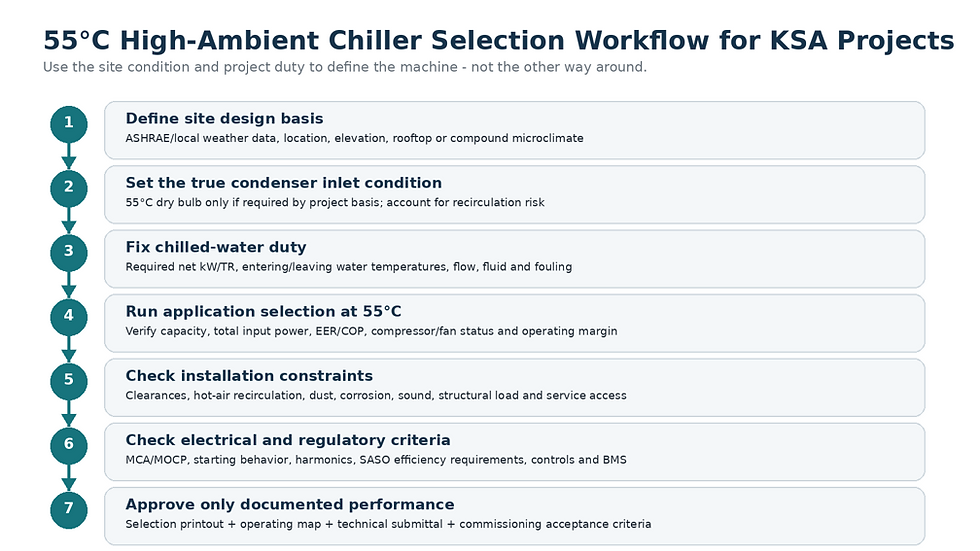
Figure 2. Recommended selection workflow for a KSA project with a 55°C ambient requirement.
Airflow and hot-air recirculation can defeat a 55°C-rated chiller
A high-ambient chiller can still underperform if the condenser is starved of air or repeatedly draws its own hot discharge air back through the coil. Trane’s air-cooled chiller application guidance warns that warm-air recirculation and coil starvation reduce capacity and efficiency by increasing head pressure. Daikin installation guidance similarly notes that multi-chiller compounds and dominant winds can create over-temperature conditions at downstream units, especially when the project operates close to the unit operating limit.
This matters in Saudi installations where chillers may sit behind architectural screens, in roof wells, between parapets, inside acoustic enclosures, or in tight multi-unit compounds. The design should verify:
· Clear inlet airflow to every condenser face.
· Unobstructed fan discharge above the chiller.
· Manufacturer-required side and end clearances.
· Spacing between adjacent chillers to prevent cross-recirculation.
· Effects of parapets, screens, walls, louvers and nearby structures.
· Prevailing wind direction and downdrafts from taller buildings.
· External static pressure if discharge ducting or screens are used.
· Maintenance access that does not compromise the condenser airflow path.
When should CFD be considered?
CFD is particularly useful when the installation geometry makes condenser recirculation difficult to judge from simple clearance rules - for example, a walled rooftop plant, a dense data-center yard, deep acoustic screens, multiple chiller banks, or buildings that create strong wind recirculation. A thermal airflow model can estimate local condenser inlet temperatures and identify whether a nominal 55°C weather condition could become a higher effective inlet temperature around the equipment.
For projects with complex airflow constraints, see ASPAR’s CFD analysis services in Saudi Arabia, which include chiller and heat-exchanger performance analysis and airflow/temperature assessment.
Other KSA conditions that matter at 55°C
High ambient temperature is only one part of the environmental design. The following conditions can materially change equipment selection or reliability and should be addressed in the same technical submittal.
Constraint | Engineering response |
Dust and coil fouling | Dust increases air-side resistance and degrades heat transfer. Provide realistic coil-cleaning access and maintenance procedures. |
Corrosion exposure | Coastal or aggressive environments may require enhanced coil and frame protection. Confirm coating impact on heat transfer and warranty. |
Solar exposure | Electrical panels, VFDs and controls exposed to direct sun can experience higher local temperatures than the shaded ambient. |
Altitude | Reduced air density can reduce condenser heat-rejection performance and fan mass flow. Use the actual project elevation. |
Power quality | At high load and high ambient, verify supply voltage, transformer/generator capacity, MCA/MOCP, harmonics and restart behavior. |
Noise limits | High condenser fan speed at extreme ambient can affect acoustic compliance. Review sound at the high-ambient operating state. |
Water temperature reset | Higher leaving chilled-water temperatures can reduce compressor lift where the process allows it; do not change the design setpoint merely to make an undersized selection pass. |
Redundancy | N+1 or modular capacity should be verified at the same 55°C design point, including failure scenarios where remaining units carry more load. |
Copy-ready specification clause: 55°C high-ambient air-cooled chiller
Specification intent The following clause is deliberately performance-based. Replace bracketed fields with the project schedule and local consultant requirements. Do not insert a manufacturer model until its 55°C application selection has been verified. |
1. The air-cooled chiller shall be suitable for continuous cooling operation at a dry-bulb temperature of 55.0°C measured at the condenser air inlet, unless a different project design condition is stated on the equipment schedule.
2. At 55.0°C condenser-entering dry bulb, site elevation of [___ m], chilled-water entering/leaving temperatures of [___/___°C], design flow of [___ L/s], fluid of [water / ___% glycol], and the scheduled fouling allowance, the unit shall deliver not less than [___ kW / ___ TR] net cooling capacity.
3. The technical submittal shall include a project-specific selection printout showing cooling capacity, total unit input power, EER/COP or kW/TR, evaporator pressure drop, refrigerant, compressor quantity and operating status, condenser fan operating point, and any capacity or control limitation at 55°C.
4. The submitted 55°C selection shall identify whether the stated duty represents full unrestricted capacity, controlled unloading, or another operating condition. A statement of “maximum ambient 55°C” without performance data at the scheduled duty shall not be considered sufficient.
5. All compressor drives, condenser fan motors, controls, sensors, electrical panels and power electronics required for normal operation shall be suitable for the stated ambient condition in the installed configuration.
6. The manufacturer’s installation requirements for condenser airflow, unit-to-unit spacing, wall/parapet clearance, service access and hot-air recirculation prevention shall be incorporated into the coordinated layout.
7. Where screens, acoustic barriers, ducted discharge, architectural enclosures or other airflow restrictions are present, the supplier shall state the allowable external static pressure and any capacity/power correction. The project engineer may require CFD or equivalent airflow analysis for complex arrangements.
8. Performance certification shall comply with the project-specified standard. For Saudi projects subject to SASO 2874:2025, the unit shall also satisfy applicable energy-efficiency requirements. Standard-rating compliance does not waive the separate 55°C application-performance requirement.
9. The electrical submittal shall include rated voltage/frequency, MCA, MOCP, full-load input, starting behavior, harmonic data where variable-speed drives are used, and any high-ambient derating of electrical components.
10. Commissioning shall verify condenser airflow is unobstructed, coils are clean, chilled-water flow is within the approved range, sensors are calibrated, high-ambient control logic is enabled, alarms are functional, and BMS points required by the project are correctly mapped.
Tender evaluation checklist for a 55°C chiller
Evaluation item | Result |
55°C is shown as condenser-entering dry bulb on the selection | Pass / Fail |
Required project cooling duty is met at 55°C | Pass / Fail |
Total input power and EER/COP at 55°C are stated | Pass / Fail |
Site elevation and chilled-water conditions match the design | Pass / Fail |
No undisclosed capacity limitation or protective unloading prevents scheduled duty | Pass / Fail |
Operating map covers the project leaving-water temperature and ambient | Pass / Fail |
Electrical components are suitable for the high-ambient condition | Pass / Fail |
Clearances and condenser airflow requirements fit the actual site | Pass / Fail |
Sound data and high-fan-speed operating mode are acceptable | Pass / Fail |
SASO/project energy-efficiency requirements are documented | Pass / Fail |
AHRI/Eurovent or project-required certification is documented | Pass / Fail |
Controls/BMS, restart, alarms and trend points are documented | Pass / Fail |
Coil protection and cleaning access suit the site environment | Pass / Fail |
Redundancy scenario is checked at the same extreme-ambient condition | Pass / Fail |
How to select a 55°C chiller step by step
1. Confirm the project design dry-bulb temperature from the basis of design, climatic data and owner/consultant criteria. Do not assume every Saudi site requires 55°C.
2. Define whether 55°C is an outdoor weather condition or the required condenser-entering air temperature after considering rooftop/compound effects.
3. Fix the actual peak chilled-water duty, leaving-water temperature, entering-water temperature, flow, fluid, fouling and site elevation.
4. Shortlist only chiller families whose published operating envelope reaches the required temperature, then obtain or use publicly available application data where possible.
5. Compare each candidate at the same 55°C condition using net cooling capacity and total unit power - not nominal tonnage alone.
6. Check condenser clearances, recirculation risk, structural load, sound, maintenance access, corrosion protection and dust-cleaning access.
7. Check electrical infrastructure at the high-ambient input condition, including supply limits, harmonics and standby-generator implications where applicable.
8. Confirm regulatory and certification requirements separately from the high-ambient performance requirement.
9. Write the approved 55°C duty and selection assumptions into the schedule, BOQ and technical specification so they cannot be diluted during procurement.
10. At commissioning, verify the installation matches the airflow assumptions used for selection and trend condenser inlet temperature, chiller load and input power during hot-weather operation.
Where ASPAR fits into a high-ambient chiller project
The technical problem is broader than choosing a product labeled “55°C.” The chiller, chilled-water duty, electrical supply, roof/plant layout, airflow, controls and commissioning criteria have to be coordinated as one system.
ASPAR’s chiller solutions in Saudi Arabia provide a useful starting point for comparing chiller technologies and application requirements. For projects where the high-ambient requirement must be integrated into the full design, ASPAR also publishes information on MEP engineering design services and CFD analysis.
For mission-critical cooling, especially data centers, the selection should also be checked against redundancy, rapid restart, power availability and plant-control strategy rather than evaluated as a standalone chiller.
See ASPAR’s data-center MEP and cooling solutions for the wider system context.
Frequently asked questions
Are there air-cooled chillers that genuinely operate at 55°C?
Yes. Public manufacturer pages from Daikin, Carrier, Trane, Airedale and Dunham-Bush document product families with 55°C ambient capability. The exact project duty still has to be verified for the selected model and conditions.
Does “maximum ambient 55°C” mean full capacity at 55°C?
No. It may describe the operating envelope rather than full design output. Require the actual cooling capacity and total input power at 55°C.
Is 55°C the mandatory design temperature for all Saudi Arabia projects?
No. Use project-specific climatic data and consultant/owner criteria. A project may choose 55°C as a resilience or extreme-ambient requirement, but it should be stated explicitly.
Can I select a chiller from the nominal tonnage and add 10% or 20% for high ambient?
That is not a reliable method. High-ambient derating is model-specific. Select the exact model at 55°C using application performance data.
Why can a rooftop chiller see hotter air than the weather report?
Hot condenser discharge can recirculate because of parapets, screens, close spacing, nearby units, wind patterns or roof geometry. The temperature entering the condenser coil can therefore exceed the meteorological ambient.
Should a 55°C air-cooled chiller be AHRI certified?
Where AHRI certification is required by the project, it is valuable for standardized performance comparison. It should be used together with a separate 55°C application selection because standard-rating certification alone does not prove the project duty at 55°C.
How does SASO 2874:2025 affect high-ambient chiller selection?
SASO 2874:2025 establishes energy-efficiency requirements and recognized test methods for large-capacity air-conditioning equipment including chillers. Compliance should be checked independently from the 55°C application-performance requirement.
What if the selected chiller is publicly rated only to 52°C?
Do not describe it as a 55°C chiller. Either select another publicly documented 55°C product or use verified application data for a configuration explicitly covering the 55°C requirement.
Is a water-cooled chiller rated by outdoor dry-bulb temperature in the same way?
Not directly. A water-cooled chiller rejects heat to condenser water, so cooling-tower design and outdoor wet-bulb conditions become the primary ambient-side constraints. The equipment still needs project-specific condenser-water conditions.
When is CFD worth using for a chiller yard?
Use CFD when walls, louvers, screens, multiple units, nearby structures or wind conditions make condenser recirculation uncertain, especially when the design point is close to the chiller’s high-ambient limit.
Conclusion
For a Saudi project with a 55°C ambient requirement, the engineering target is not simply to find a chiller brochure that contains the number 55. The target is a documented machine selection that still delivers the project cooling duty, at the required chilled-water conditions and site elevation, with acceptable input power, airflow margin, electrical performance, sound and reliability.
Publicly documented 55°C air-cooled chillers are available. The strongest procurement approach is to define 55°C as an application condition, compare candidates at that exact point, and protect the selected performance through the BOQ, technical specification, coordinated layout and commissioning plan. That approach turns an extreme Saudi climate constraint into a measurable engineering requirement rather than a marketing claim.
Need a Project-Specific 55°C High-Ambient Chiller Solution? ASPAR Engineering Can Help
A 55°C requirement becomes meaningful only when it is converted into a model-specific selection at the actual condenser-entering condition. ASPAR Engineering can support consultants, contractors, developers, and facility owners in defining the required cooling duty, comparing appropriate chiller technologies, and coordinating the selected equipment with the real project environment in Saudi Arabia.
That support can extend beyond equipment selection. ASPAR MEP engineering design services can coordinate chilled-water duty, electrical supply, controls, BMS, structural and rooftop constraints, while ASPAR CFD analysis services can assess condenser-air recirculation, airflow restrictions, screens, parapets, and dense multi-chiller layouts when the effective condenser inlet temperature may exceed the weather-station ambient.
For mission-critical facilities such as data centers, ASPAR Data Center MEP & Cooling Solutions provide a wider system context for redundancy, power availability, restart strategy, controls, and cooling resilience. Project-specific high-ambient capability must still be verified from the offered equipment selection and technical submittal before procurement.
Ready to evaluate a high-ambient chiller for your project? Explore ASPAR Chiller Solutions | Discuss Your Project with ASPAR Engineering |

Comments